All your questions answered in one place.
In today’s rapidly changing world, education must equip students with the knowledge and skills needed to thrive in a technology-driven global society. STEM education. an interdisciplinary approach that focuses on Science, Technology, Engineering, and Mathematics – has become an essential part of modern learning. At The Cambridge School Doha- one of the best international schools in Doha, STEM education is integrated into the curriculum to encourage innovation, critical thinking, and problem-solving, helping students prepare for the challenges and opportunities of the future.
Since its establishment in 2001, The Cambridge School Doha has remained committed to providing a globally responsive education that blends strong academic foundations with creativity, cultural values, and a motivated approach to learning. Over the years, the school has built a strong reputation as one of the respected British curriculum schools in Doha, offering high-quality education for students from Kindergarten (KG) to Year 13.
As part of the well-known Taleb Group of Companies, which has played a leading role in the education sector in Qatar for more than two decades, the school continues to maintain high standards of academic excellence while embracing innovation in teaching and learning.
Integrating STEM into the British Curriculum
At The Cambridge School Doha, the academic programme is based on the UK National Curriculum, with a strong focus on key subjects such as English, Mathematics, Science, and Arabic. STEM education naturally fits into this framework by encouraging students to connect scientific knowledge with practical applications and technological advancements.
Rather than teaching science and mathematics as isolated subjects, STEM learning promotes an integrated approach where students explore how these disciplines work together in real-world situations. Through experiments, digital tools, and collaborative projects, students learn how to apply theoretical concepts to solve practical challenges.
This approach encourages curiosity and creativity while strengthening analytical thinking. Students are encouraged to ask questions, investigate ideas, and explore innovative solutions, helping them develop the mindset needed for the careers of tomorrow.
Encouraging Innovation Through Practical Learning
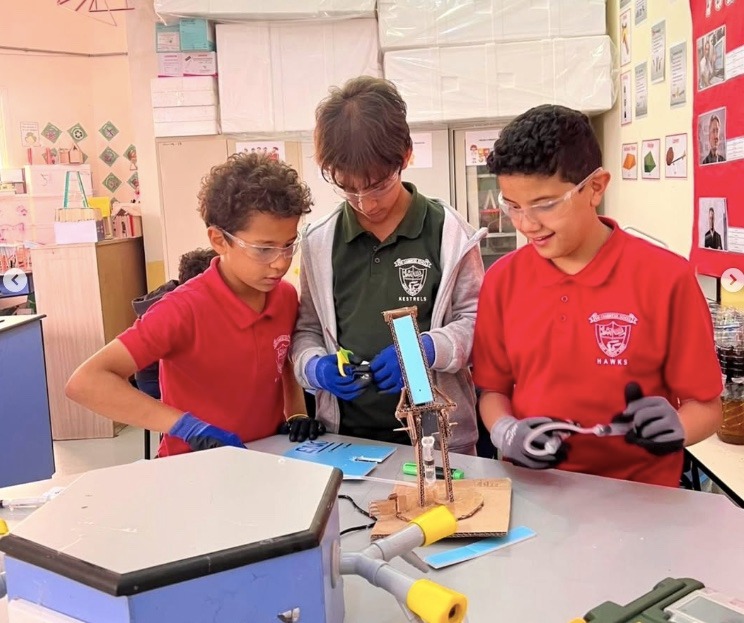
One of the most important aspects of STEM education is hands-on learning. At The Cambridge School Doha, students benefit from modern facilities that support practical exploration and experimentation. The campus features advanced ICT laboratories, well-equipped science laboratories, and interactive learning spaces designed to inspire innovative thinking.
These facilities allow students to experiment with scientific concepts, develop digital skills, and explore engineering principles in engaging ways. By participating in practical activities, students gain a deeper understanding of how scientific and technological ideas can be applied to solve real-world problems.
The school environment itself encourages active learning. As students move through the vibrant corridors of the campus, they are surrounded by an atmosphere that promotes curiosity, collaboration, and discovery. The hum of learning is evident in classrooms, laboratories, and creative spaces where students are constantly exploring new ideas and expanding their knowledge.
Developing Essential Future Skills
STEM education is not only about mastering academic subjects; it is also about developing essential skills that students will need throughout their lives. At The Cambridge School Doha, STEM learning helps students develop critical thinking, research skills, creativity, and the ability to analyse complex problems.
Students learn to approach challenges logically and systematically while also thinking creatively about possible solutions. They develop confidence in working with technology, interpreting data, and communicating their ideas effectively. These skills are highly valued in universities and modern workplaces, making STEM education a powerful tool for preparing students for future success.
Collaboration is another key aspect of STEM learning. Students often work in teams on projects and investigations, learning how to share ideas, listen to different perspectives, and work together toward a common goal. This collaborative environment builds communication skills and fosters a sense of responsibility and teamwork.
Learning Beyond the Classroom
At The Cambridge School Doha, education extends beyond traditional classroom instruction. The school believes that a well-rounded education includes opportunities for students to explore their interests and develop talents outside of academic lessons.
A wide range of extracurricular activities complements the academic programme, allowing students to engage in science clubs, innovation projects, sports, arts, and cultural activities. These experiences encourage students to develop creativity, leadership, and confidence while discovering their passions.
The school’s facilities support this holistic approach to education. From creative art and music rooms to playgrounds, libraries, and a swimming pool, the campus is designed to provide students with opportunities for both intellectual and personal development.
The dedication of The Cambridge School Doha to academic excellence and innovation is reflected in its accreditations and achievements. The school is accredited by the Qatar National School Accreditation (QNSA) and the Western Association of Schools and Colleges (WASC), both widely recognised as indicators of quality education.
Over the years, the school has received numerous awards acknowledging its contributions to education and community development. These include recognition for community service, environmental initiatives such as Green School programmes, and outstanding academic achievements through the Cambridge Outstanding Learner Awards.